
Why DevOps and Cloud Now Decide Enterprise Competitiveness
Why DevOps and Cloud Now Decide Enterprise CompetitivenessBy Super Admin | January 14, 2026 | Cloud & Edge Computing
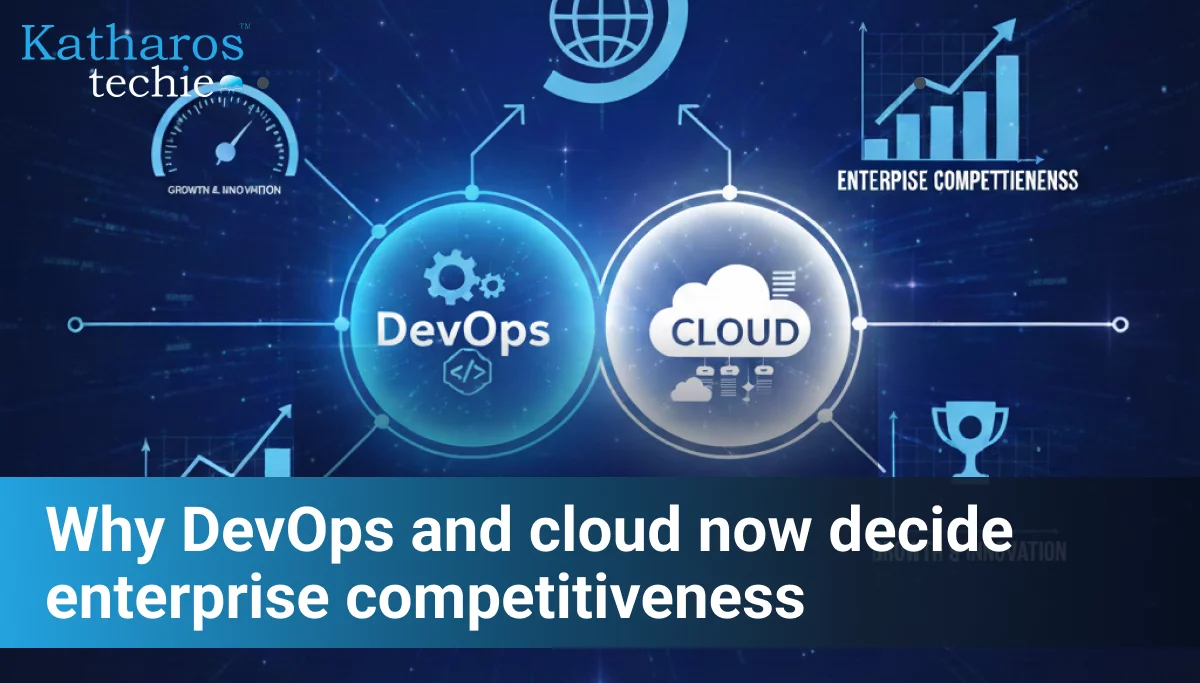
Enterprise competitiveness has quietly changed shape.
For decades, advantage came from scale, capital, and operational efficiency. Large organizations won because they could invest more, hire more, and operate more reliably than smaller players. That logic no longer holds. Today, markets move faster than governance cycles. Customer expectations shift faster than annual roadmaps. Technology evolves faster than procurement models were ever designed to handle.
What separates competitive enterprises from stagnant ones is no longer size or reach. It is execution speed, adaptability, and the ability to translate strategy into working systems without friction.
This is where DevOps and cloud computing in enterprises transition from being IT initiatives to becoming business drivers.
The Enterprise Competitiveness Shift
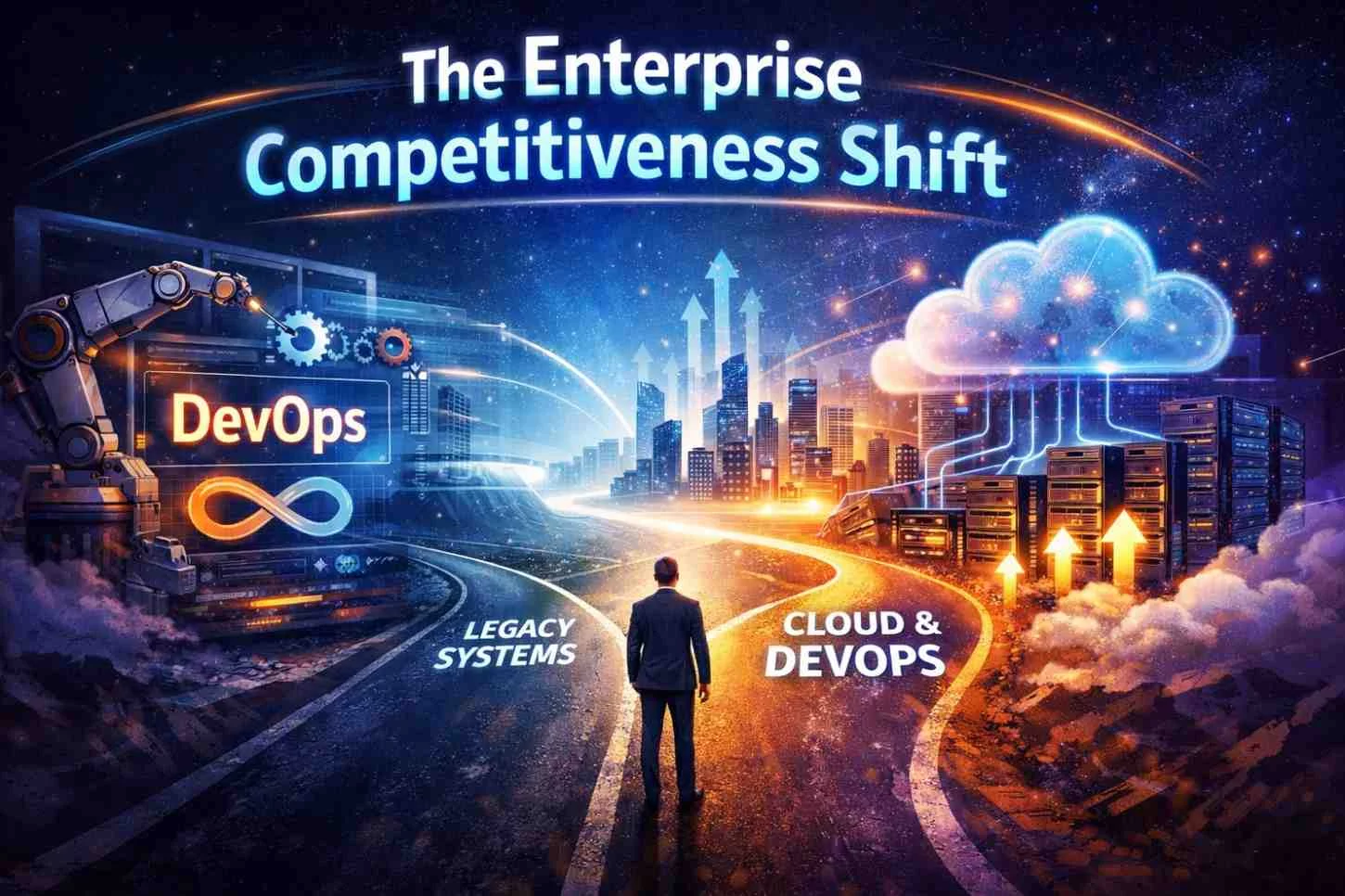
Modern enterprises are operating under constant pressure from three directions.
First, customers expect digital experiences to improve continuously. Static platforms and slow release cycles are no longer tolerated. Second, competitors are no longer constrained by geography or infrastructure. Cloud native companies can enter markets faster and iterate more aggressively. Third, uncertainty is the norm. Regulatory shifts, supply chain disruptions, and economic volatility demand rapid, coordinated operational responses that traditional enterprise operating models struggle to deliver.
Traditional enterprise IT models were not built for this environment. Long release cycles, siloed teams, and rigid infrastructure create latency between intent and action. By the time a system goes live, the business context may already have shifted.
Cloud-driven business transformation addresses part of this problem by removing infrastructure bottlenecks. DevOps addresses the rest by eliminating organizational and delivery bottlenecks. Together, they redefine how enterprises compete.
Why Cloud Became the Enterprise Foundation
Cloud adoption is no longer about cost optimization or data center exit strategies. Most enterprises have already moved workloads to the cloud. Yet many fail to see meaningful performance gains. The reason is simple. Migration without modernization preserves old problems on new platforms.
True cloud transformation for enterprises focuses on how systems are designed, operated, and evolved.
Enterprise cloud modernization means moving away from monolithic architectures, static environments, and manual provisioning. It means embracing elasticity, resilience by design, and platform abstraction. It also means aligning cloud capabilities directly with business priorities such as faster launches, geographic expansion, and data-driven decision-making.
However, cloud alone does not improve enterprise performance. It creates potential. Whether that potential becomes a competitive advantage depends entirely on how software is built, deployed, and operated.
This is why cloud native enterprise strategy and DevOps strategy must be designed together, not sequentially.
DevOps as the Enterprise Execution Engine
DevOps matters for business because it shortens the distance between decision and delivery.
At its core, DevOps is not a tooling practice. It is an operating model that aligns engineering, operations, security, and business stakeholders around shared outcomes. In enterprises, this alignment is both more complex and more critical.
DevOps adoption in enterprises differs from that in startups. Large organizations must balance speed and compliance, autonomy with governance, and innovation with stability. This is precisely why DevOps for business competitiveness requires intentional design, not ad hoc experimentation.
When implemented correctly, DevOps transforms cloud platforms into execution engines. Features move from idea to production faster. Feedback loops shrink. Failures become recoverable events rather than reputational crises.
The business benefits of DevOps and cloud are not abstract. They translate into faster time to market, higher system availability, and the ability to respond to market signals without structural friction.
Enterprise DevOps Strategy Is Not About Tools
Many enterprises stall because they mistake DevOps tooling for DevOps strategy.
Buying CI CD platforms, container platforms, or monitoring tools does not automatically change how work flows through the organization. Without structural alignment, tools simply automate inefficiencies.
An enterprise DevOps strategy defines how teams collaborate, how decisions are made, and how accountability is distributed. It addresses questions such as who owns reliability, how security is embedded into delivery pipelines, and how platform teams support product teams.
For large organizations, this strategy must also integrate with governance frameworks, audit requirements, and regulatory obligations. The DevOps maturity model for large organizations emphasizes incremental capability building rather than radical disruption.
This is where experienced DevOps consulting services become valuable. They help enterprises design operating models that work within real constraints rather than theoretical ideals.
For organizations aiming to align DevOps with broader technology capabilities such as cloud engineering, platform engineering, and digital transformation initiatives, a unified services overview, such as https://katharostechie.in/our-services, fits naturally at this point in the discussion.
DevOps Automation at Enterprise Scale
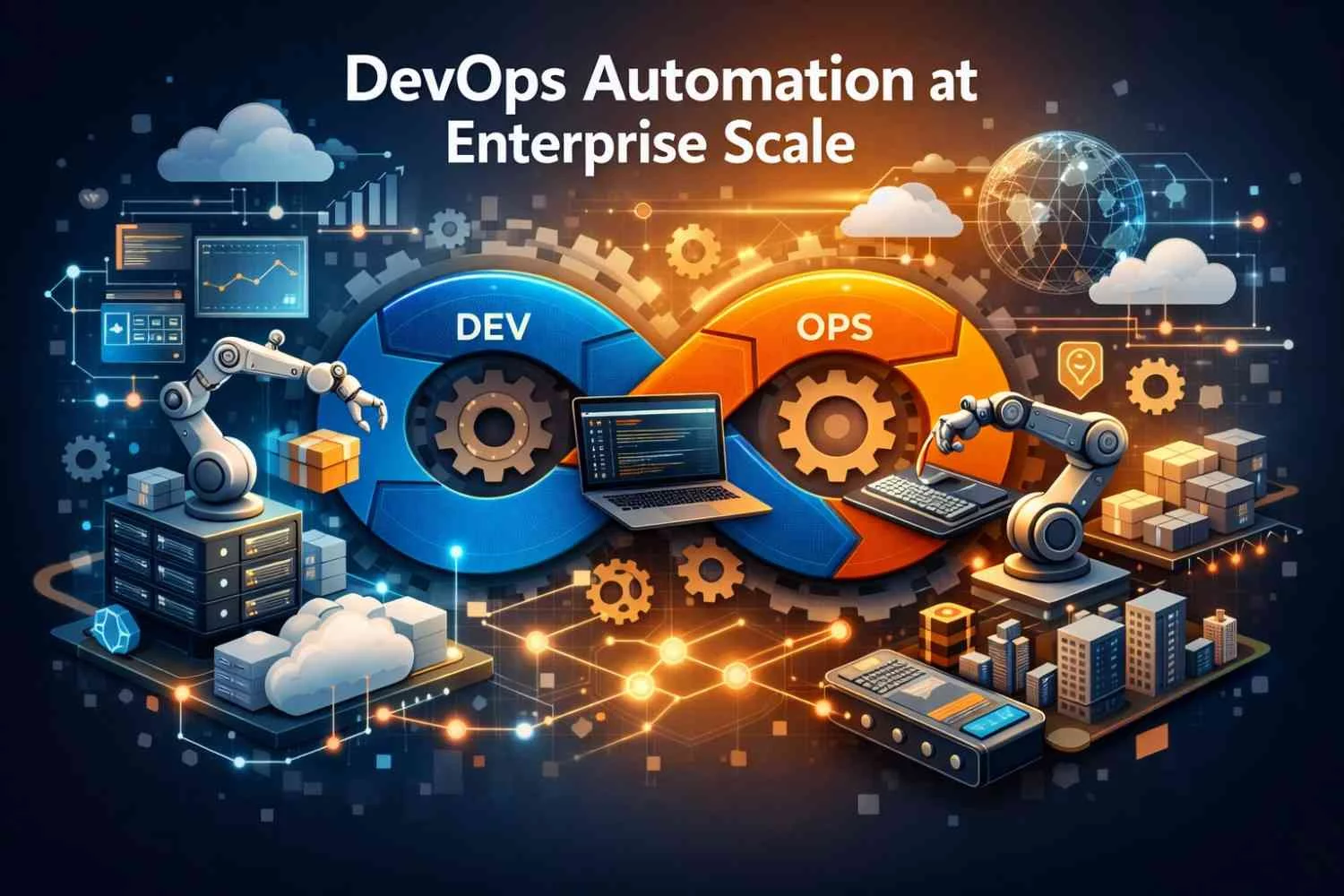
Speed without control is chaos. Control without speed is stagnation.
DevOps automation for enterprises resolves this tension by embedding policy, security, and quality directly into delivery pipelines. Automation ensures consistency while enabling teams to move faster.
At scale, automation goes beyond build and deployment pipelines. Infrastructure as code standardizes environments. Policy as code enforces compliance automatically. Observability platforms provide real-time insight into system health and performance.
These capabilities unlock DevOps and cloud scalability benefits that manual processes cannot match. Enterprises can support multiple product teams, multiple regions, and multiple compliance regimes without proportional increases in operational overhead.
Automation also improves predictability. Releases become routine rather than risky. Recovery becomes faster because systems are designed to fail safely.
Measuring DevOps ROI for Enterprises
Executives do not invest in practices. They invest in outcomes.
DevOps ROI for enterprises should be measured in business terms, not vanity metrics. Faster deployment frequency matters only if it leads to faster revenue realization. Reduced incident counts matter only if they protect customer trust and brand value.
Cloud improves enterprise performance by enabling elastic scaling, high availability, and faster experimentation. DevOps ensures these capabilities are actually used.
Organizations that track DevOps ROI effectively focus on metrics such as time to market, customer experience scores, operational resilience, and cost efficiency at scale. Over time, they also see improvements in talent retention, because engineers prefer environments where they can deliver meaningful work without constant friction.
Cloud and DevOps as a Single Strategy
Separating cloud strategy from DevOps strategy is one of the most common enterprise mistakes.
Cloud without DevOps results in underutilized platforms and rising costs. DevOps without cloud hits hard limits around scalability, resilience, and global reach. Competitiveness emerges only when both are treated as a unified system.
A cloud native enterprise strategy aligns infrastructure, platforms, delivery pipelines, and organizational design around shared goals. It treats software delivery as a core business capability rather than a support function.
This integrated approach allows enterprises to adapt continuously rather than through periodic transformation programs.
The Role of Consulting in Enterprise Transformation
Most enterprises understand what needs to change. Fewer know how to change it without disrupting ongoing operations.
Digital transformation consulting, enterprise cloud consulting, and DevOps consulting services help bridge this gap. Their value lies not in frameworks but in pattern recognition. Experienced consultants have seen where transformations stall and where they succeed.
A capable DevOps consulting company does more than implement pipelines. It helps align leadership expectations, redesign operating models, and build internal capability. It accelerates transformation while reducing risk.
For enterprises evaluating partners, linking readers to a comprehensive services overview, such as https://katharostechie.in/our-services, provides a natural next step to explore how cloud, DevOps, and digital transformation services can be integrated.
Choosing the Right DevOps Consulting Company
Not all consulting partners are equal.
Enterprises should look beyond certifications and tool expertise. What matters is experience operating at scale, across industries, and within regulated environments. The right partner understands that transformation is as much about people and incentives as it is about technology.
A strong DevOps consulting company helps enterprises move from fragmented initiatives to coherent execution. It builds systems that teams can own long after consultants leave.
Cloud and DevOps Adoption Challenges: Enterprises Underestimate
Cloud adoption challenges for enterprises are rarely technical; they are organizational.
Resistance to change, legacy performance metrics, and misaligned incentives slow down transformation. Security teams fear loss of control. Operations teams fear instability. Business leaders fear disruption.
DevOps adoption in enterprises succeeds when these concerns are addressed explicitly. Transparency, shared ownership, and incremental progress matter more than bold declarations.
Organizations that acknowledge these realities upfront move faster in the long run.
The Future Belongs to Adaptive Enterprises
Enterprise competitiveness will increasingly belong to organizations that can sense change early and respond decisively.
DevOps and cloud-driven business transformation enable this adaptability. They allow enterprises to experiment, learn, and evolve without betting the business on every decision.
As AI, platform engineering, and advanced analytics become embedded across enterprise systems, the gap between organizations built to adapt and those constrained by rigid operating models will widen.
DevOps and cloud are no longer differentiators. They are prerequisites. The real question for enterprises is not whether to invest, but how quickly they can turn these capabilities into sustained competitive advantage.


Related Blogs

Let us digitalize your ideas.
Contact Us